
Intership M2
- Share
- Share on Facebook
- Share on LinkedIn
Job description / Training
RESEARCH OPPORTUNITY:
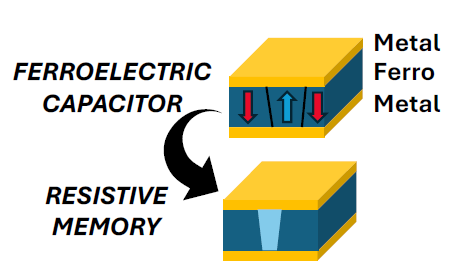
The electronic von Neumann architecture has today reached its energy limits, hindering the deployment of high-performance AI at the edge. To overcome this bottleneck, neuromorphic electronics based on Spiking Neural Networks (SNNs) and the In-Memory Computing (IMC) paradigm have emerged as the leading solution. This M2 internship project proposes to study hybrid memories that can function as both ferroelectric capacitors and resistive memories using a single material stack. These hybrid devices are particularly promising for implementing differentiated synaptic behaviors. The devices to be studied were developed and fabricated in several variants on 300 mm wafers at CEA-Leti. The memories consist of a ferroelectric Hf0.5Zr0.5O2 (HZO) layer between 6 and 10 nm thick, which underwent ion implantation with different species (e.g. Si, B). This implantation aims to promote the memristive behavior of the layer. We are seeking a motivated Master 2 student passionate about materials science, microelectronics, and AI to characterize these hybrid devices and contribute to the emerging field of ultralow-power neuromorphic electronics.
SCIENTIFIC CHALLENGES:
Within an ecosystem of experts, you will lead the following research axes:
• Development of semi-automated measurement protocols: You will develop C-V, I-V, and pulsed measurement protocols adapted to the statistical study of ferroelectric capacitors (e.g., PUND) and resistive memories (Forming, SET, RESET). You will use the 300 mm prober at CROMA (full wafer) and the new LOTUS-X3 measurement equipment at LTM, opening new opportunities for multi-channel studies between CROMA and LTM.
• Study of technological parameters: You will study the influence of HZO thickness, electrode nature, and ion implantation (dose, species) on the ferroelectric, capacitive, and memristive properties of the devices.
• Physical understanding: You will analyze defect distribution, interface quality (C-V, admittance), capacitance noise, and conduction modes.
• Identification of optimal variants: You will identify the technological variants offering the best compromise between ferroelectric polarization (2Pr), endurance, low Forming voltage, and low variability.
AN EXCEPTIONAL ENVIRONMENT IN EUROPE:
The internship will take place within a collaboration between the Laboratory of Technologies for Microelectronics (LTM) and the Centre for Radiofrequencies, Optics and Micro-nanoelectronics in the Alps (CROMA), members of the LabEx Microelectronics, located in the heart of Europe's largest R&D hub for nanotechnologies.
• Technology platforms: You will benefit from direct access to state-of-the-art electrical characterization labs at CROMA, LTM and CIME Nanotech.
• Network & collaborations: Your work will leverage strategic collaborations between LTM, CROMA and CEA-Leti for advanced electrical characterizations for neuromorphic device exploration. This internship will help structure the LTM-CROMA collaboration in the emerging memories and neuromorphic electronics axis.
• Excellence training: You will develop a unique hybrid profile (materials physics, emerging memory devices, neuromorphic electronics) within a world-renowned interdisciplinary ecosystem. Results will be valorized through seminars and publications.
Candidate profile:
Requires enrollment in a Master 2 program in Microelectronics, Materials Science, or Nanotechnologies. You demonstrate academic excellence and confirmed experimental skills in electrical characterization and Python programming. Scientific rigor, autonomy, curiosity and fluent technical English are required. A strong interest in experimental research, emerging memories and brain-inspired technologies for low-power AI is essential.
Application: Please submit your CV, transcripts from the last two years, and, if possible, letters of recommendation.
Contact: yann.beilliard univ-grenoble-alpes.fr (yann[dot]beilliard[at]univ-grenoble-alpes[dot]fr)
Supervisors: LTM: Y. Beilliard, CROMA: F. Ducroquet, Q. Rafhay, C. Theodorou
Download
2027_StageM2_LTM_CROMA_FeRAM-OxRAM.pdf (PDF, 134.3 KB)
- Share
- Share on Facebook
- Share on LinkedIn