- Share
- Share on Facebook
- Share on LinkedIn
Call for proposals, Conference / Scientific culture
From 14 December 2026 to 15 December 2026
Grenoble - Presqu'île
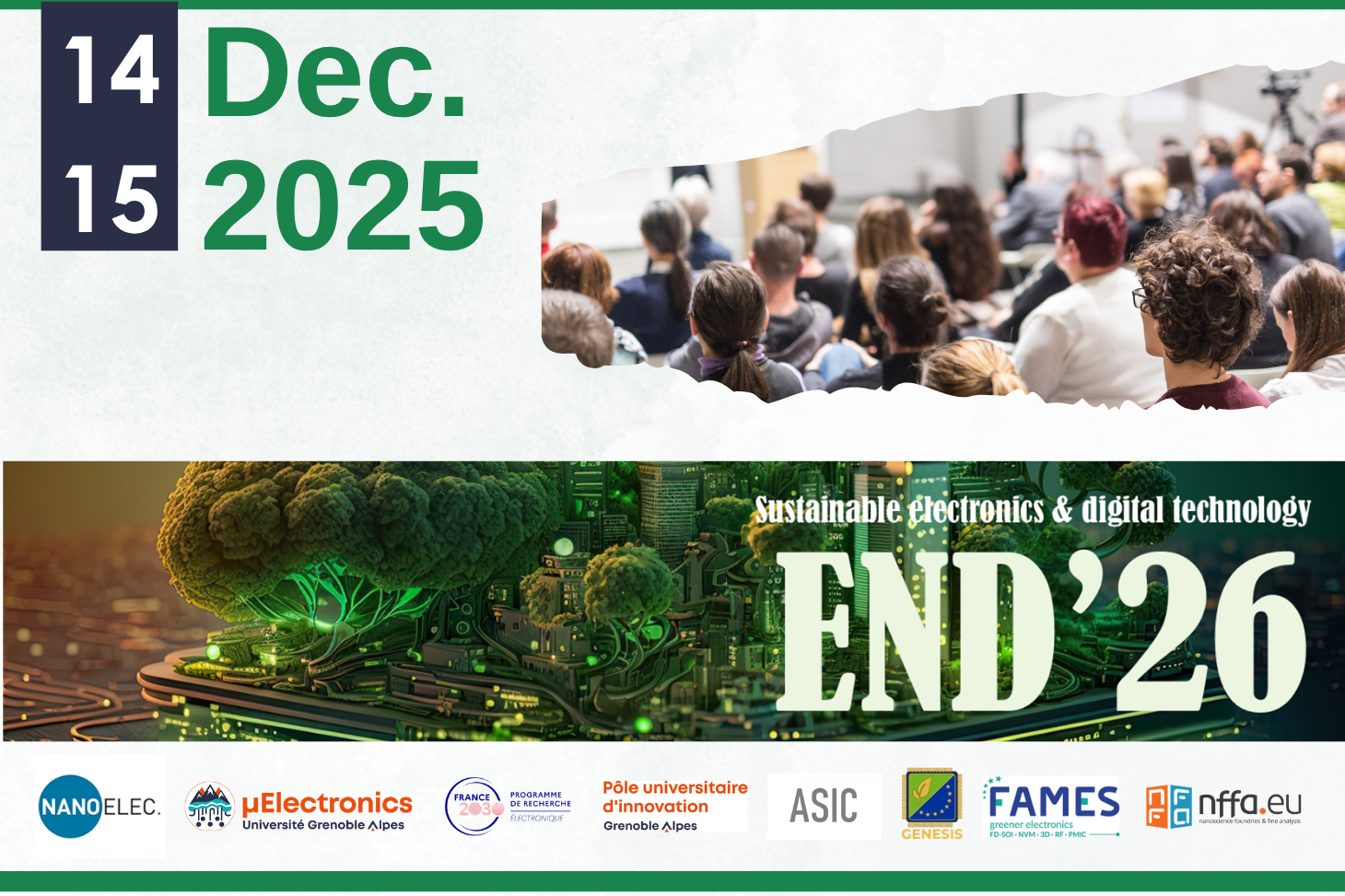
The Symposium on Responsible Electronics and Digital Technology returns for its third edition in December 2026 on a European scale. Each year, this gathering aims to be even more innovative and ambitious than the previous ones; the event will now take place over two days, December 14 and 15, featuring a day of tutorials followed by a day of mini-conferences.
All the information about " https://end26.sciencesconf.org/?lang=en " is available at:
Call for Papers Now Open
L'appel à contributions est ouvert jusqu'au 12 octobre 2026. Il est possible de déposer des contributions afin de proposer un format tutoriel pour le 14 décembre, ou un poster ou un oral pour la journée du 15 décembre.
You must log in to sciencesconf.org to submit your proposal using the submission form at https://end26.sciencesconf.org/index/unauthorized (website in English).
Please note that registration and participation in the Symposium are free for those submitting an abstract; to do so, simply send an email to nanoelec cea.fr (nanoelec[at]cea[dot]fr) to get a promo code.
Scientific Topics
Measure to Take Action
- Metrics for evaluating innovation projects and programs in the sector, taking into account planetary boundaries and social minima, and highlighting positive externalities.
- Life Cycle Assessment (LCA) Tailored to Microelectronics — Alternative Sustainability Indicators Beyond the Carbon Footprint.
- Modeling the Impact on All Hardware and Software Supply Chains — Standardization, Certification, and Reference Frameworks.
- Assessment of the social contribution of information and communication technologies (ICT) to justice, health, information, and democracy.
Rethinking Design at the Source:
- The challenges of the digital transition as a subject of academic interest in and of itself.
Design and analysis methods and tools that incorporate, among other factors, impacts on climate change, chemical pollution, mental health, markets, and freshwater use, while taking into account product lifespans and circularity. - Resource-efficient functions and services, integration of code and dedicated electronics — Energy-efficient software and hardware architectures and processing strategies.
- Substitution and the development of safe (sustainable and self-sufficient) materials — Design and value chain strategies that prioritize repair, reusability, or refurbishment on a societal scale.
- Deployment of “appropriate technologies” for dedicated and targeted applications — Open-source hardware and software as a new driver for accelerating responsible innovation and impact.
Reducing the Impact of Value Chains
- Eco-design as an academic discipline of learning and research — Eco-design at the heart of technological developments.
Sustainable packaging and encapsulation methods for combining the processing of heterogeneous and asynchronous information. - Tight software-hardware integration on standalone, embedded, and edge computing platforms.
- Generic codes as building blocks for new services — Circular practices — Hardware and software obsolescence.
- Low-impact manufacturing techniques (reduction in temperature, energy, water, and gas consumption) — Cleaner chemical processes and reduction in precursors.
- A focus on technologies for efficient, smart, and secure systems that support French and European competitiveness. This could address a variety of future challenges, such as high-performance computing centers, artificial intelligence, mental and physical health, transparency and the democratization of information (combating fake news), energy, cities, and the measurement or display of data and images.
Date
Localisation
Grenoble - Presqu'île
- Share
- Share on Facebook
- Share on LinkedIn