Development of red and RGB μLEDs for microdisplays and high-speed communication
- Share
- Share on Facebook
- Share on LinkedIn
Thesis / Employment, Recruitment
Background:
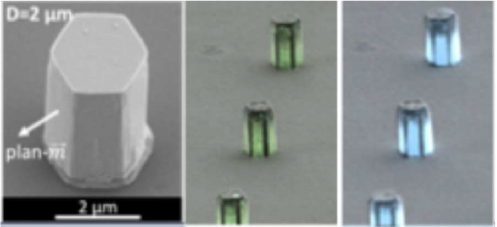
MicroLEDs (μLEDs) are a promising technology for the development of high-brightness mini-displays (such as augmented reality glasses or smartwatches). Measuring less than 20 μm in size, these μLEDs are produced by etching a planar structure on sapphire that incorporates InxGa1-xN quantum wells. The emitted wavelength is directly tuned by the indium content x of the quantum wells (x ≈ 15% for blue, 25% for green, 35–40% for red). While nitride semiconductors offer excellent performance in the blue spectrum, efficiency drops sharply as the size of the μLEDs decreases. To overcome this issue, an innovative approach involves microwire technology with a core-shell geometry. This architecture preserves emission efficiency regardless of size and enables data transmission at GHz speeds (technology developed by the Grenoble-based startup Aledia). Despite their strong potential, core-shell microwire LEDs still face a major scientific challenge: achieving red emission. Indium incorporation remains limited to 25%, a threshold insufficient to reach red. This technological bottleneck is currently hindering the emergence of RGB trichromatic μLEDs. Our team has achieved pioneering results in this field, where we created the first InGaN core-shell quantum well at 15% for blue emission and 25% for green emission. Despite these advances, the challenge of achieving red emission remains.
Objectives:
A new idea has emerged to go beyond 25% of In-content for core-shell microwire technology and thus aim for the first demonstration of red emission, which led to a patent application in 2025. Preliminary results have proven very promising results, and we wish to continue this work through a thesis with the three main objectives:
- Demonstrate red emission by varying the geometric parameters of the microwires (diameter, etc.)
- Produce red μLEDs
- Produce trichromatic RGB μLEDs in a single growth run
Collaborations:
This project relies on close collaboration with the LTM (Laboratory of Microelectronics Technology) for the fabrication of GaN microwire arrays via plasma etching process. Epitaxial studies of core/shell LEDs will be conducted at CEA’s PHELIQS facility using the MOCVD epitaxial setup, incorporating structural and optical analyses. The final step aims to fabricate microwire-based μLED devices using the expertise developed at the Néel Institute via the NanoFab cleanroom.
Why join this project?
To gain expertise in epitaxy, semiconductor physics, plasma etching, nanofabrication and optoelectronics. To work in a dynamic and collaborative environment closely linked to the industrial sector. To contribute to the development of next-generation μLEDs for microdisplays and GHz communications.
PhD Funding:
This thesis project is funded by the UGA’s Labex “μelectronics.”
Contacts:
Christophe.durand cea.fr (Christophe[dot]durand[at]cea[dot]fr) (Pheliqs/CEA)
erwine.pargoncea.fr (erwine[dot]pargon[at]cea[dot]fr) (LTM/CNRS)
Join to your application:
CV, transcripts (engineering school, or master 1/master 2) and eventually letters of recommendation
- Share
- Share on Facebook
- Share on LinkedIn