
- Share
- Share on Facebook
- Share on LinkedIn
Research
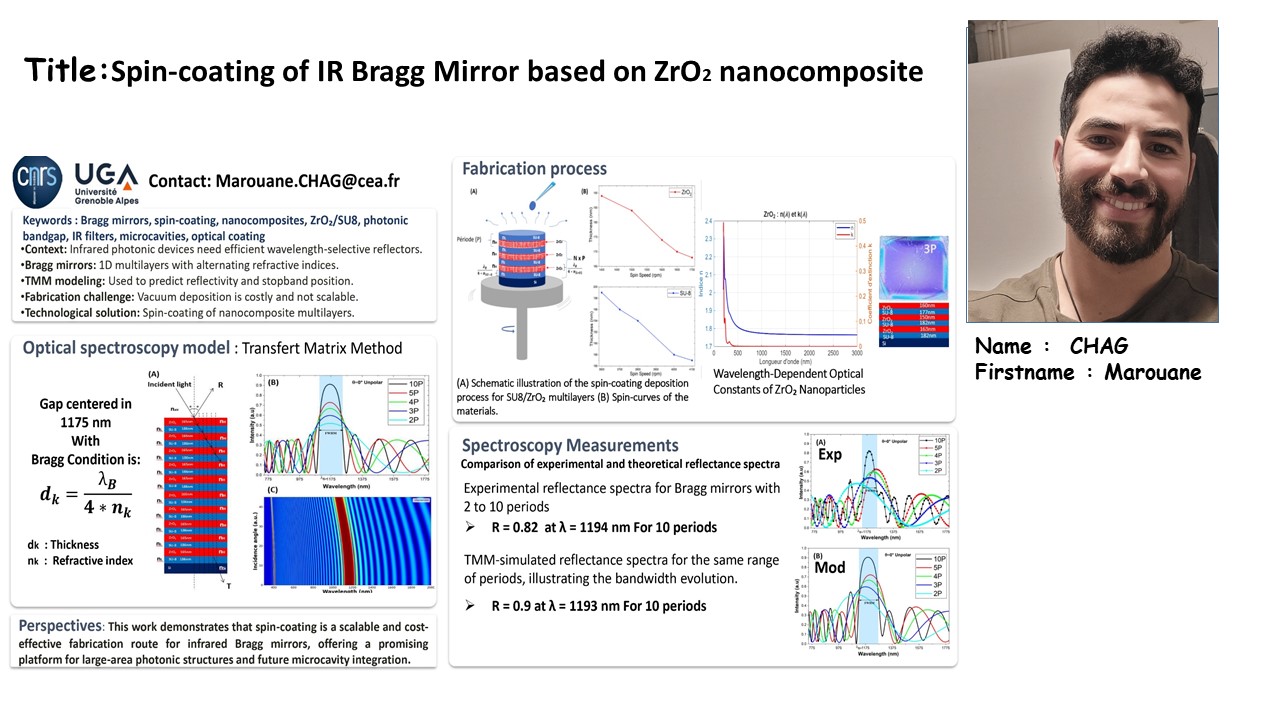
Bragg mirrors are periodic multilayer structures widely used in photonics to reflect specific wavelengths and form microcavities, but their conventional vacuum-based fabrication is costly and hard to scale. This study proposes spin-coating as a low-cost, scalable alternative, using a high-index-contrast SU8/ZrO2 nanocomposite multilayer (ΔRI ≈ 0.2) designed to center the photonic bandgap at 1175 nm.
The ZrO2 resist (5 nm nanoparticles in PGMEA with Irgacure photoinitiator) is alternately deposited with SU8 by spin-coating, with each layer thickness set to the quarter-wave condition (SU8 = 165 nm, ZrO2 = 186 nm). Transfer Matrix Method simulations predict ~81% reflectance and 154 nm FWHM for a 10-period stack, with thickness variability under 10% confirmed by ellipsometry.
Experimental UV-Vis-IR spectrometry validates the design, showing a bandgap centered at 1190 nm with 82% reflectance and FWHM of 106 nm (vs. 150 nm predicted), the discrepancy mainly attributed to humidity and temperature fluctuations during spin-coating. Overall, the work demonstrates that spin-coating combined with functional nanocomposites is a viable route for simpler, scalable fabrication of Bragg mirrors and microcavities, opening perspectives for further optimization of layer deposition parameters.
- Share
- Share on Facebook
- Share on LinkedIn